
Chicago & Illinois Police Brutality Statistics: What the Data Reveals About Accountability and Reform
Illinois has faced ongoing criticism over police misconduct and a lack of accountability. From Chicago to smaller cities statewide, excessive force and missing oversight have damaged trust between communities and law enforcement.
Each statistic tells a story about real people and the systems meant to protect them. Examining the data helps us understand how often force is used, who is most affected, and whether reform efforts are making a difference. This article breaks down Illinois police brutality statistics and what the numbers reveal about progress toward meaningful change.
On This Page:
- Overview of Police Brutality in Illinois
- Chicago’s Role in Illinois Police Violence Statistics
- Hotspot Neighborhoods and Complaint Clusters
- The Accountability Crisis in Illinois Policing
- How Illinois Police Misconduct Compares Nationally
- Gaps and Limitations in Illinois Police Data
- Steps To Take if You Find Yourself or a Loved One a Victim of Police Brutality
- How Illinois Police Misconduct Compares Nationally
Overview of Police Brutality in Illinois
Illinois has a long history of police misconduct. Over the years, residents have raised concerns about excessive force, racial profiling, and a lack of transparency within police departments.
Use of Force and Fatalities
From 2013 to 2023, police officers in Illinois were involved in 285 fatal encounters statewide. Between 2016 and 2022, residents filed more than 12,000 civilian complaints of police misconduct, including 2,363 reports of excessive or unnecessary force. Despite the volume of complaints, few cases have led to meaningful discipline.
Illinois officers used deadly force at a rate of 3.2 incidents for every 10,000 arrests, and 11% of those killed were unarmed. These numbers put Illinois above the national average for both overall use of force and unarmed fatalities.
Racial Disparities in Police Violence
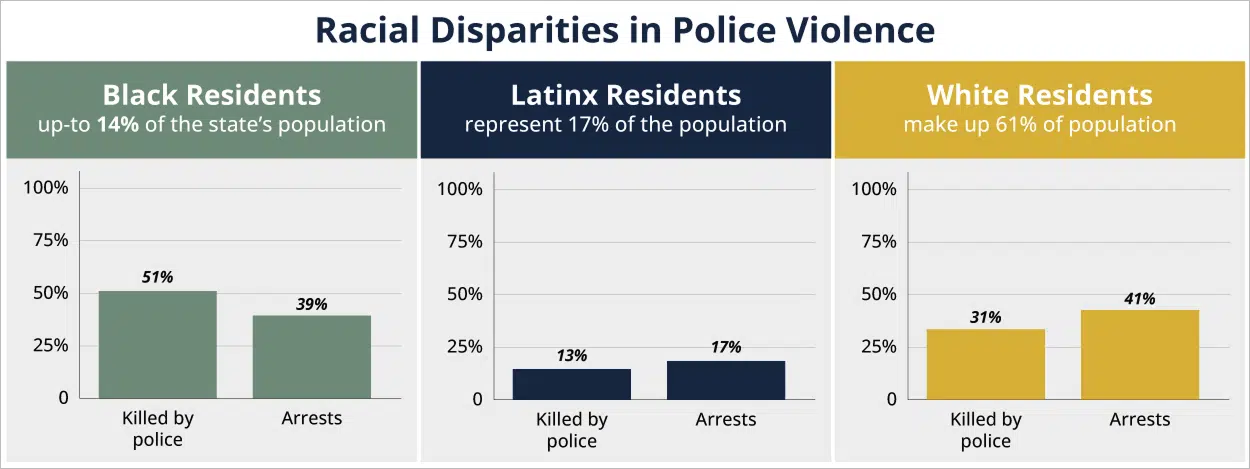
Illinois ranks worse than 89% of states for racial disparities in deadly force. Black residents are 3.6 times more likely—and Latinx residents 1.6 times more likely—to be arrested for low-level, nonviolent offenses than White residents.
Perhaps even more startling, a Black person in Illinois was 7.1 times more likely to be killed by police than a White person from 2013 to 2023. Latinx people in the state were 1.5 times as likely to be killed by police. These numbers point to patterns of systemic bias.
Arrest and Budget Trends
Between 2013 and 2023, Illinois recorded 883,272 arrests. More than half of those were for low-level, nonviolent offenses. Arrests reached their lowest point in 2020, with just over 5,900 statewide, before climbing sharply to 165,922 by 2023.
During that same period, police budgets continued to grow. Illinois spent more than $6.2 billion on law enforcement in 2022. That’s more spending per person than 79% of states. The state also employed roughly 29,300 officers, ranking near the national midpoint for police presence per capita.
This data suggests that increased spending has not reduced the number of arrests for minor offenses. Instead, they highlight how heavy investments in policing often go hand in hand with aggressive enforcement, especially in communities already over-policed for low-level crimes.
Chicago’s Role in Illinois Police Violence Statistics
Chicago heavily influences Illinois’ police misconduct data. As the state’s largest city, it accounts for many of the arrests, misconduct complaints, and police-involved deaths reported statewide. It also sets the standard for smaller cities—when Chicago struggles with accountability in policing, those failures ripple across Illinois.
Chicago’s Accountability and Performance Scores
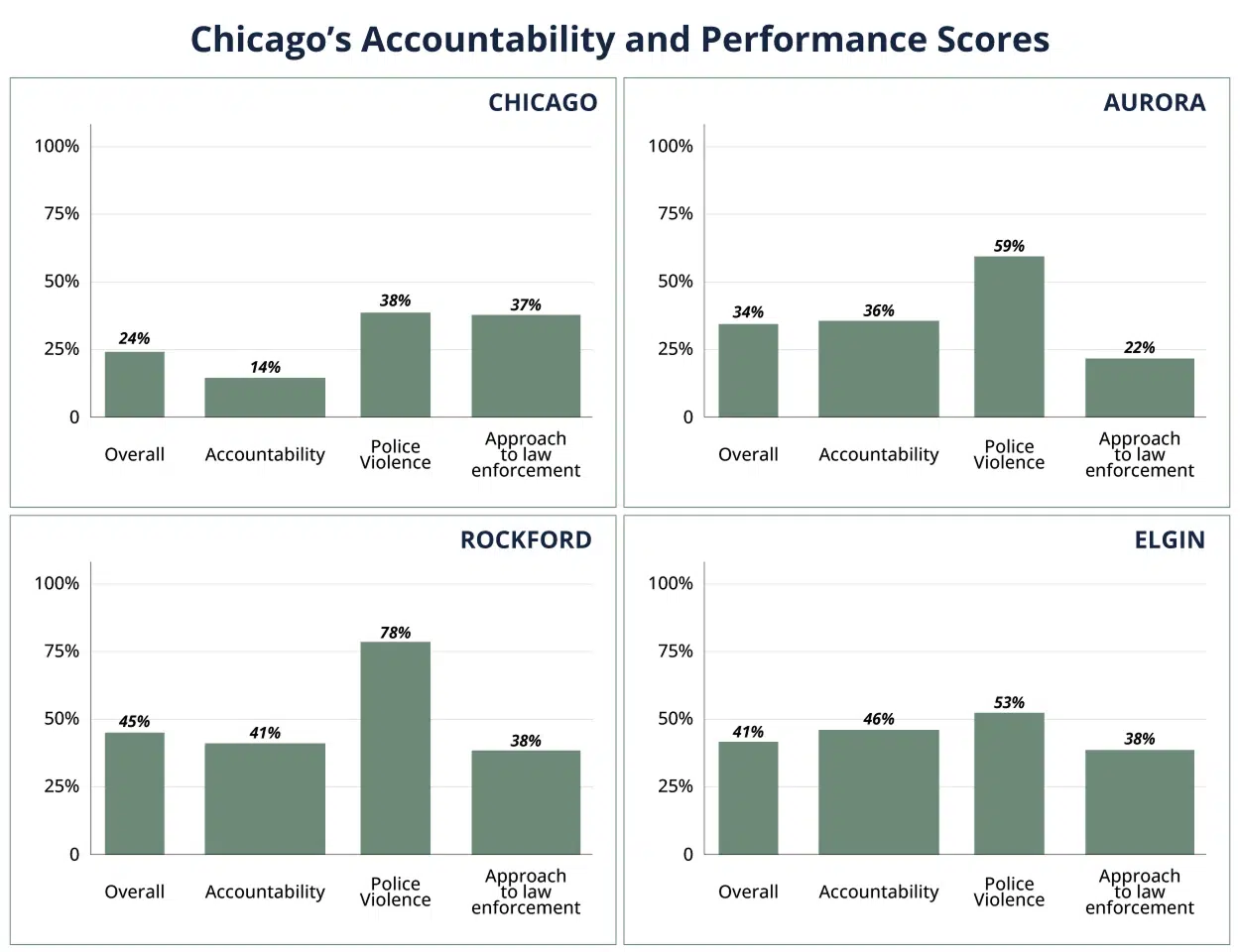
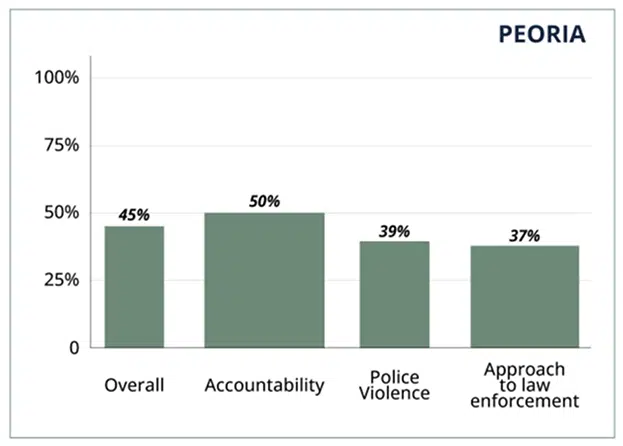
Police Scorecard data shows that Chicago ranks lowest among major Illinois cities for accountability and use of force:
- Chicago: 24% overall | 14% accountability | 38% police violence | 37% approach to law enforcement
- Aurora: 34% overall | 36% accountability | 59% police violence | 22% approach
- Rockford: 45% overall | 41% accountability | 78% police violence | 38% approach
- Elgin: 41% overall | 46% accountability | 53% police violence | 38% approach
- Peoria: 45% overall | 50% accountability | 39% police violence | 37% approach
Scores range from 0% to 100% for cities with 100,000 to 250,000 residents. Higher scores mean departments use less force, make fewer arrests for low-level offenses, and hold officers accountable more often. Chicago’s consistently low marks highlight how much work remains to improve transparency.
Hotspot Neighborhoods and Complaint Clusters
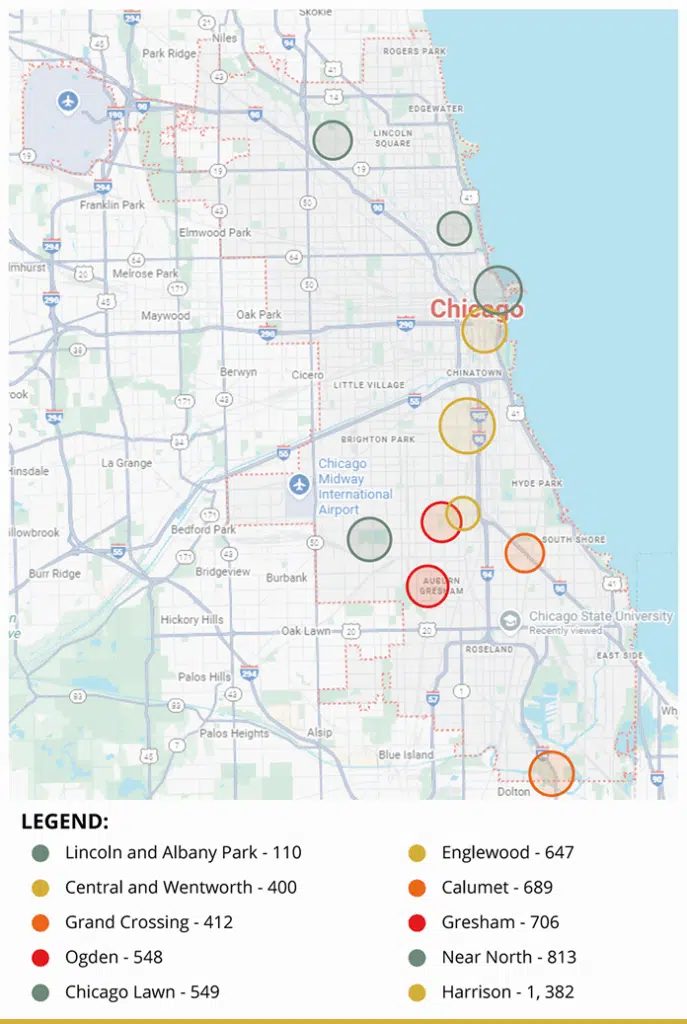
From 2019 through 2025, the highest numbers of allegations with formal findings were concentrated in several Chicago police districts. Harrison recorded the most with 1,382 sustained allegations, followed by Near North with 813, Gresham with 706, and Calumet with 689.
Other districts with significant formal findings include Englewood with 647, Chicago Lawn with 549, Ogden with 548, and Grand Crossing with 412. Central and Wentworth each exceeded 400 findings.
By contrast, Lincoln and Albany Park reported fewer than 110 formal findings over the same period. The gap highlights deep disparities in how residents across the city experience policing.
Reform Progress in Chicago
The Chicago Police Department has operated under a federal consent decree since 2019, a court order requiring major reforms. Six years later, the department has fully complied with just 16% of those mandates.
The department is in preliminary compliance with 34% of reforms and in secondary compliance with 42%, so further improvement may be on the horizon. Despite this, use-of-force incidents rose 47% from 2023 to 2024.
The Accountability Crisis in Illinois Policing
Illinois law enforcement agencies face a major accountability shortfall. While residents make thousands of complaints yearly, only a small fraction lead to meaningful discipline.
Complaint Volume vs. Disciplinary Outcomes
From 2016 to 2022, Illinois recorded 12,345 civilian complaints of police misconduct, and just 9% of those were ruled in favor of civilians. The state’s overall police accountability score is just 5%, indicating systemic failures in holding officers accountable for misconduct.
In one example, the Joliet Police Department’s internal review found formal complaints from community members were sustained in fewer than 10% of cases. At the same time, internal complaints by officers were sustained nearly 74% of the time.
Barriers to Accountability
Union contracts across Illinois make it difficult to discipline officers. One analysis found that contracts “stand in the way” of accountability by allowing closed investigations before meaningful discipline. These protections make it difficult for departments to remove repeat offenders.
Lawmakers passed the 2021 SAFE-T Act to expand oversight through the Professional Conduct Database, which records officer discipline, suspensions, and investigations. However, a last-minute amendment sealed the database and exempted it from the Freedom of Information Act, or FOIA.
As a result, courts and the public cannot access its records. Anyone who wants statewide misconduct data must file separate FOIA requests with nearly 900 police agencies, a process that restricts transparency and weakens accountability across Illinois.
How Illinois Police Misconduct Compares Nationally
To understand Illinois’ challenges with police accountability, it’s important to view the state’s patterns alongside national trends.
States Leading in Police Reform
Several states have taken stronger steps than Illinois to make police oversight transparent and enforceable. For example, Colorado enacted one of the nation’s most comprehensive reform laws in 2020, which requires body cameras for all officers, bans qualified immunity in state courts, and mandates public reporting of all use-of-force incidents and disciplinary actions.
Maryland repealed its decades-old Law Enforcement Officers’ Bill of Rights and replaced it with an independent accountability board system, giving civilians a direct role in reviewing misconduct cases. In addition, New York opened police disciplinary records to the public by repealing Section 50-a, which had long kept them sealed.
Trend Analysis—Is Illinois Improving?
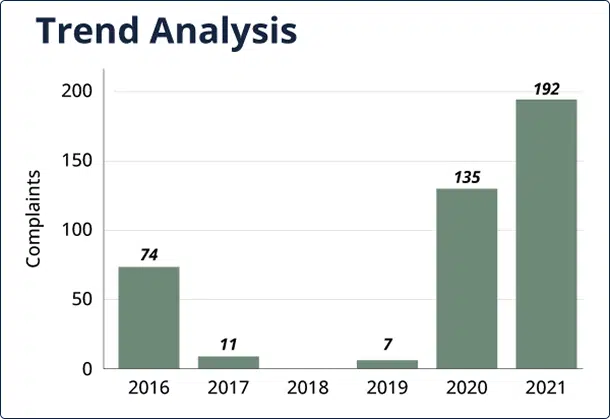
Civilian complaints against police in Illinois have grown sharply in recent years. Illinois police misconduct data shows just 74 complaints in 2016. The number dropped to 11 in 2017 and 7 in 2019 before surging to 135 in 2020 and 192 in 2021.
The rise began during the height of nationwide protests over police violence. That means the data could reflect both increased public reporting as well as heightened tensions between police and civilians
Gaps and Limitations in Illinois Police Data
Illinois has taken steps toward greater transparency, but major gaps remain. Many encounters with law enforcement never make it into official reports, which limits the state’s ability to hold departments accountable.
Missing Department Data
Many Illinois departments still fail to submit complete information on basic incidents or arrests. This raises questions about how consistently they also report internal misconduct.
When Illinois adopted the national incident-based reporting system, dozens of agencies submitted no data for most of 2022. This includes major police departments, such as Aurora and Waukegan.
Unrecorded Incidents and Context
Official records don’t tell the whole story, as many police misconduct incidents never appear in official records. Police intimidation, close calls with excessive force, and the psychological toll of frequent police contact don’t always leave a paper trail.
Why Better Data Collection Is Critical
Consistent digital reporting and open access are the foundation of any meaningful reform effort. When departments fail to release data, policymakers and communities cannot track patterns or hold officials accountable. Illinois can only start achieving real progress when it has complete, standardized, and public data.
Steps To Take if You Find Yourself or a Loved One a Victim of Police Brutality
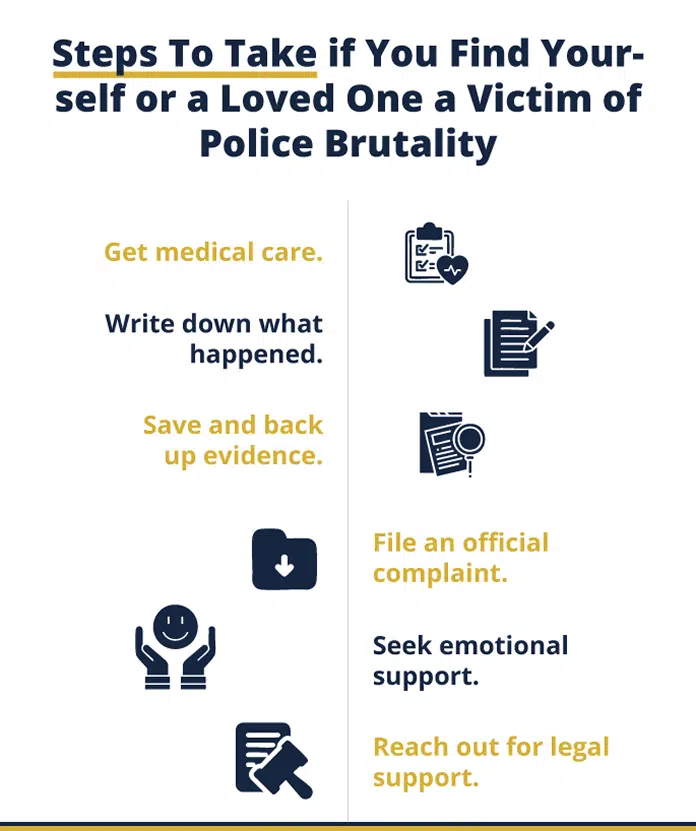
If you’ve experienced police violence in Illinois, you deserve support and accountability. Healing and justice take time, but there are concrete steps you can take to protect yourself as you move forward:
- Get medical care. Seek treatment immediately, and keep all medical records related to the incident.
- Write down what happened. Record names, badge numbers, locations, and witness details while your memory is fresh.
- Save and back up evidence. Keep videos, photos, and messages in a safe place. Don’t delete or edit them.
- File an official complaint. Report the incident to the Civilian Office of Police Accountability or the Illinois State Police Division of Internal Investigation.
- Seek emotional support. Connect with a mental health therapist who is experienced in trauma recovery.
- Reach out for legal support. Contact a Chicago police misconduct lawyer or a nonprofit advocacy group such as the ACLU of Illinois for professional guidance.
How Illinois Police Misconduct Compares Nationally
Illinois police brutality statistics highlight patterns of excessive force that leave lasting wounds across communities. Families and survivors have the right to seek justice, even when the system feels stacked against them. Legal action can hold officers and departments accountable, uncover the truth, and help prevent future harm.
If you or someone you love has suffered from police violence in Illinois, Levin & Perconti can help you understand your rights and explore your options. Our Chicago police brutality and shooting lawyers are committed to fighting for accountability and helping survivors rebuild their lives.