A recent analysis of Centers for Disease Control and Prevention (CDC) data conducted by The Commonwealth Fund shows that the U.S. has not improved its disproportionately high rates of pregnancy-related deaths compared to other developed countries. The U.S. is one of seven countries where maternal mortality rates have significantly increased between 2000 and 2023, while they have mostly fallen elsewhere in that time frame.
While rates are stabilizing after broadly spiking during the COVID-19 pandemic, data from 2023 and 2024 shows maternal deaths in the U.S. are stagnating around previous levels—with significant racial disparities continuing to worsen.
Read on for more information on key findings from the latest reports.
Key Findings Alarming to U.S. Women
- The U.S. has the worst maternal mortality rate among “high-income” countries at 18.6 deaths per 100,000 births in 2023, roughly triple that of nations like Japan, Germany, France, and Sweden.
- Though the U.S.’s maternal mortality rate fell to 17.9 deaths per 100,000 births in 2024, that drop doesn’t show a statistically significant shift in the right direction.
- The U.S. ‘s deaths per live birth were mostly stagnant throughout the 2010s before nearly doubling during the COVID-19 pandemic. Data from 2024 shows that deaths have fallen to near pre-pandemic levels but still remain elevated compared to other nations.
- About 63% of pregnancy-related deaths occurred within a year after giving birth, significantly eclipsing deaths before or during birth.
- Though the maternal mortality rate among Black women fell from 2023 to 2024, it remains significantly higher than those of other races.
- Women aged 40 and older were five times more likely to die from childbirth or pregnancy complications than those younger than 25.
- Rural areas generally have worse maternal death rates than urban areas, though both often suffer from care access issues.
- In every year from 2018 to 2023, pregnancy-related mortality rates in states that haven’t expanded Medicaid eligibility under the Affordable Care Act were 18% to 49% higher than in states that have.
- Overall death rates for young women in the U.S. have risen even more sharply than pregnancy-related deaths, with substance use problems being the largest contributor.
Understanding Maternal Mortality
There are three commonly used measures of maternal deaths in the United States. While they all capture some aspect of maternal deaths, they are not equivalent:
- Pregnancy-associated death: Death while pregnant or within one year of the end of the pregnancy, irrespective of the cause.
- Pregnancy-related death: Death during pregnancy or within one year of the end of pregnancy from a pregnancy complication, a chain of events initiated by pregnancy, or the aggravation of an unrelated condition by the physiologic effects of pregnancy. Used in the U.S. only, this CDC measure is typically reported as a ratio per 100,000 births.
- Maternal mortality: Death while pregnant or within 42 days of the end of pregnancy, irrespective of the duration and site of the pregnancy, from any cause related to or aggravated by the pregnancy or its management, but not from accidental or incidental causes. Used by WHO in international comparisons, this measure is reported as a ratio per 100,000 births.
How Race and Ethnicity Impact Maternal Mortality Rates
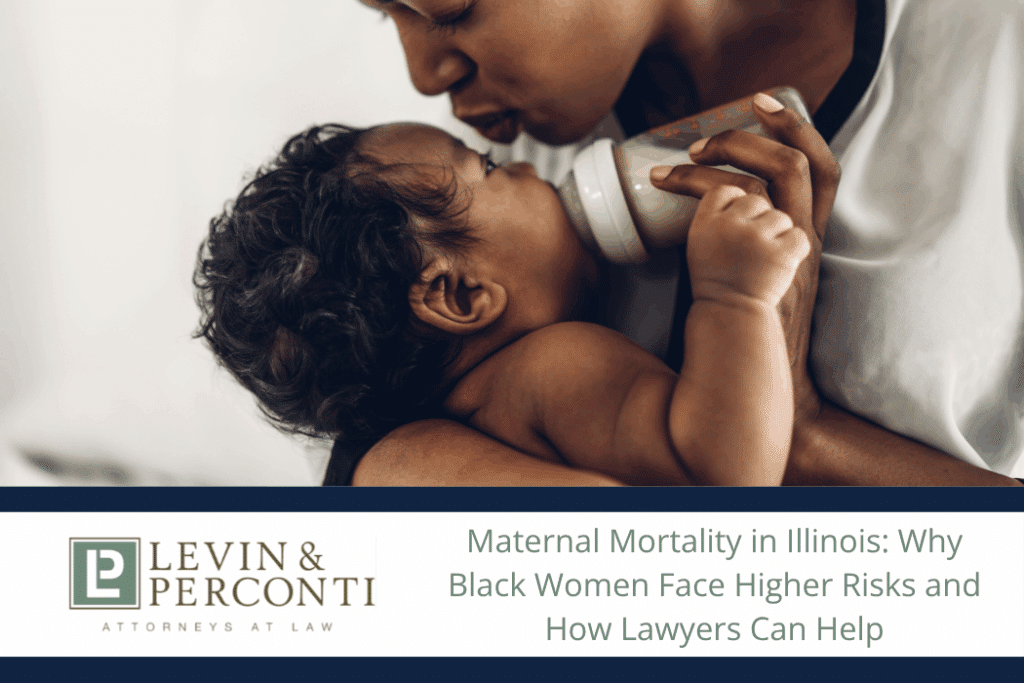
Black mothers experienced 49 deaths per 100,000 live births from 2022 to 2023, a rate roughly three times that of white, Hispanic, and Asian mothers in that same period. American Indian and Alaska Native mothers also saw significantly worse mortality rates than other ethnicities.
While these racial disparities existed prior to the COVID-19 pandemic, they’ve only grown more pronounced since 2020. While most demographics’ mortality rates have returned to levels roughly similar to before the pandemic, Black and Native mothers are still at significantly higher risk of death, up nine and 10 deaths per 100,000 births respectively.
The Illinois Department of Public Health (IDPH) found in its November 2025 Maternal Mortality Data Report that 91% of the state’s pregnancy-related deaths from 2021 to 2022 were potentially preventable. Black women remained significantly more likely than white women to die from pregnancy conditions or complications, with Chicago among the areas with the state’s worst maternal mortality rates.
Keep Illinois Hospitals and Healthcare Systems Accountable
Proper medical supervision and treatment must be rendered at all times during pregnancy and the birth process. When a doctor fails to provide adequate care and an injury occurs, the doctor and hospital may be liable for damages. If you suspect medical negligence may have contributed to a maternal injury or death, please contact Levin & Perconti toll-free at 877-374-1417 or in Chicago at (312) 332-2872 for a FREE consultation.
Sources: Eugene Declercq and Laurie C. Zephyrin,, Maternal Mortality in the United States, 2025
(Commonwealth Fund, July 2025). https://www.commonwealthfund.org/publications/issue-briefs/2025/jul/maternal-mortality-united-states-2025
Donna L. Hoyert Ph.D., Maternal Mortality Rates in the United States, 2024 (CDC National Center for Health Statistics, March 2026) https://www.cdc.gov/nchs/data/hestat/hestat113.htm
Illinois Maternal Mortality Data Report Nov. 2025 (Illinois Department of Public Health, Nov. 2025) https://dph.illinois.gov/resource-center/news/2025/november/release-20251125.html